
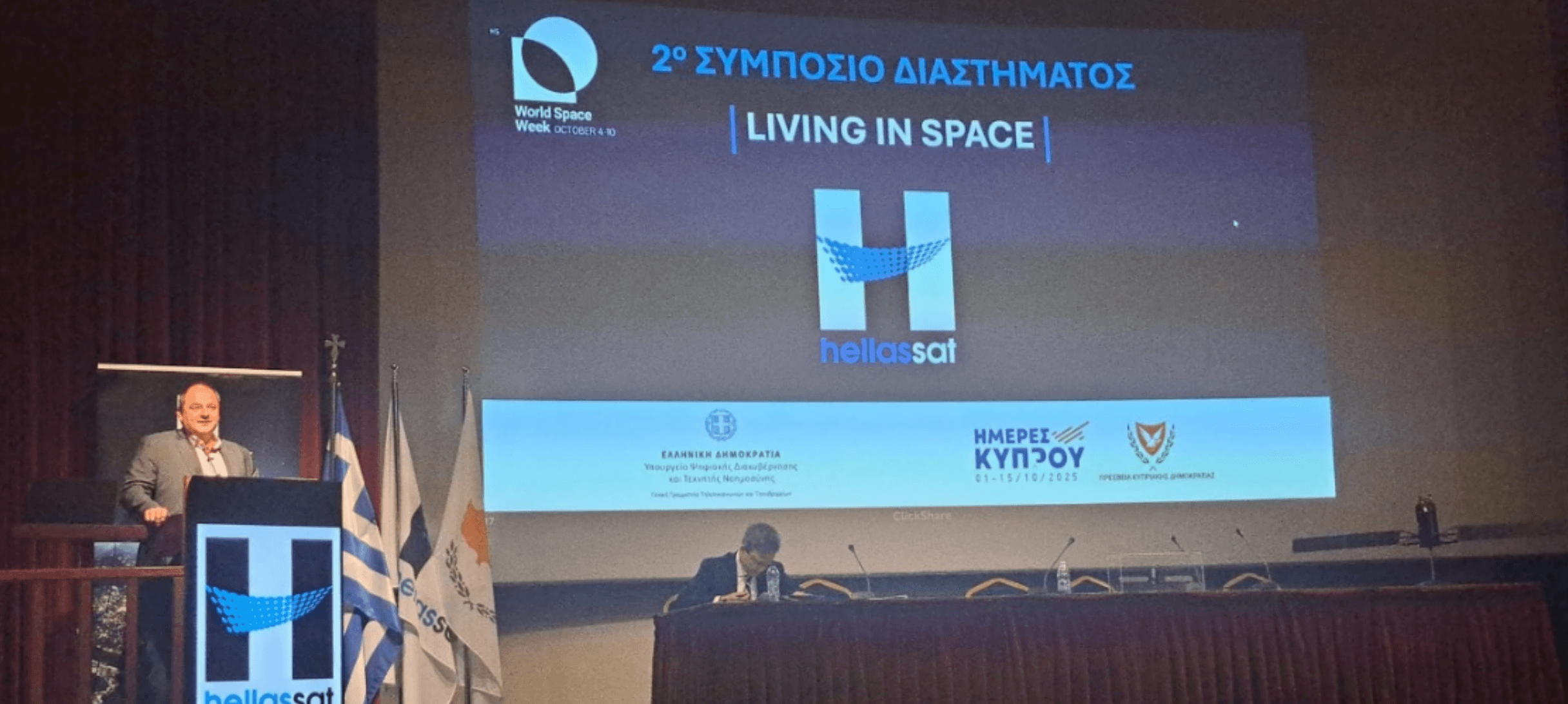
At the Symposium, among other important personalities, the Minister of Digital Governance Dimitris Papastergiou, the Ambassador of the Republic of Cyprus in Athens, and the General Secretary of Telecommunications and Post Konstantinos Karantzalos were hosted on the panel "Greece and Cyprus: Strategy and Vision for the Future." The discussion analyzed Greece's key priorities in the field of Space, with an emphasis on operational dimension, technological autonomy, and interoperability of critical infrastructures.
In his speech, the General Secretary emphasized that Space is now internationally recognized as an operational domain, equal to land, sea, air, and cyberspace. It is no longer a field of observation but an active operational environment. In this context, he highlighted the need to develop technologically mature systems in Greece that can operate in Space, both for security reasons and for strategic independence and autonomy, while simultaneously utilizing the country's scientific personnel. "The goal is, apart from today's Hellas Sat satellites, to have over 20 Greek satellites in orbit by 2026," Mr. Karantzalos noted.
Additionally, he referred to the challenges posed by the speed of technological transformation in areas such as telecommunications, space, and robotics, in contrast to the time-consuming processes of public tenders. As he characteristically said, when the time from the expression of a need to the final procurement and operation of a system exceeds four or five years, the solution designed risks being technologically outdated. He also stressed that the global shift towards smaller and more flexible space systems must be accompanied by more flexible, transparent, and adaptive tendering processes that allow for stages of maturation, demonstration, and adaptation of technologies.
Finally, he made special mention of the scheduled acceptance and addition of Cyprus as an associate member to the Council of the European Space Agency (ESA - European Space Agency) on October 22 in Paris, an event that Greece actively supported throughout the previous period. In closing, he emphasized that operational autonomy in the Eastern Mediterranean, and beyond, requires close cooperation between Greece and Cyprus with common, strategically significant systems and interoperabilities.
On the occasion of World Space Week, the need to strengthen the domestic technological base, develop Greek production lines, and implement joint actions that will boost the country's presence in the international technological and space ecosystem is highlighted more than ever. The utilization of the highly qualified Greek scientific workforce can transform Greece from a spectator to a protagonist in developments, charting a course of autonomy, innovation, and extroversion.