
The National Microsatellite Program is Greece's primary national initiative for developing autonomous space capabilities and Earth Observation services. It is implemented by the Ministry of Digital Governance and Artificial Intelligence, through the General Secretariat of Telecommunications and Post, in collaboration with the European Space Agency (ESA) and the Hellenic Space Center (HSC), with funding from the Recovery and Resilience Facility "Greece 2.0".
The program is the core of Greece's strategy for developing national space infrastructure and utilizing satellite data for the benefit of the state, the economy, and society. It started in 2024 and is gradually evolving until the full operational functionality of the satellite and ground infrastructures.
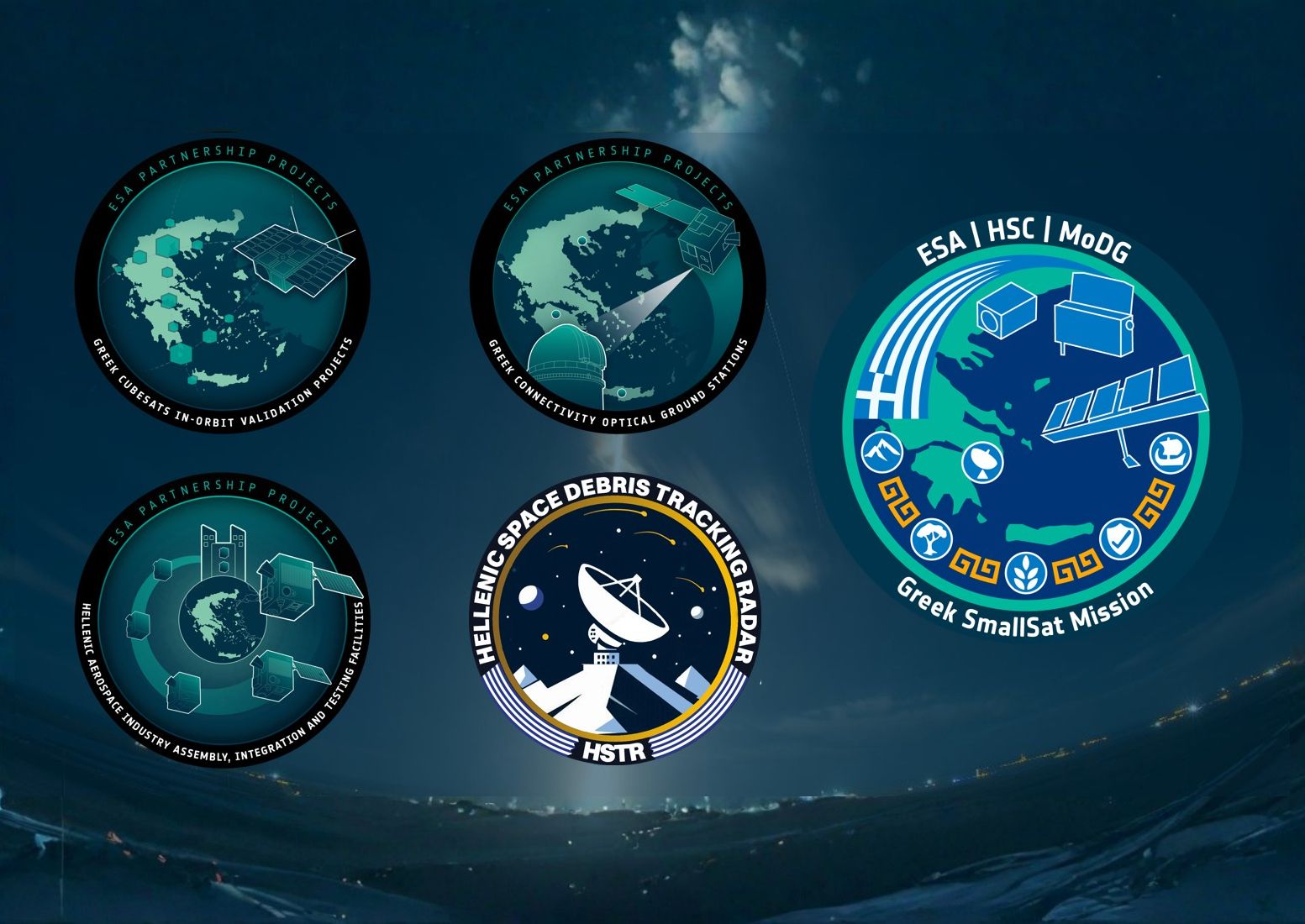
Within the framework of the program, the following are being developed:
• constellation of seven (7) optical microsatellites,
• constellation of four (4) thermal microsatellites,
• constellation of two (2) synthetic aperture radar (SAR) microsatellites,
• eleven (11) experimental CubeSats for In-Orbit Validation (IoV), aiming to develop Greek expertise and demonstrate new space technologies,
• ground optical communication infrastructures,
• the Hellenic Space Tracking Radar (HSTR),
• the Hellenic Assembly, Integration & Testing Facility (HAITF).
Overall, the program includes 24 satellites, providing Earth observation capabilities, early warning of natural disasters, environmental monitoring, precision agriculture, maritime surveillance, and support for public administration.
The goal of the program is to create an integrated, nationally controlled ecosystem of space infrastructures, enhancing the country's technological autonomy, national resilience, and the development of the Greek space industry.
